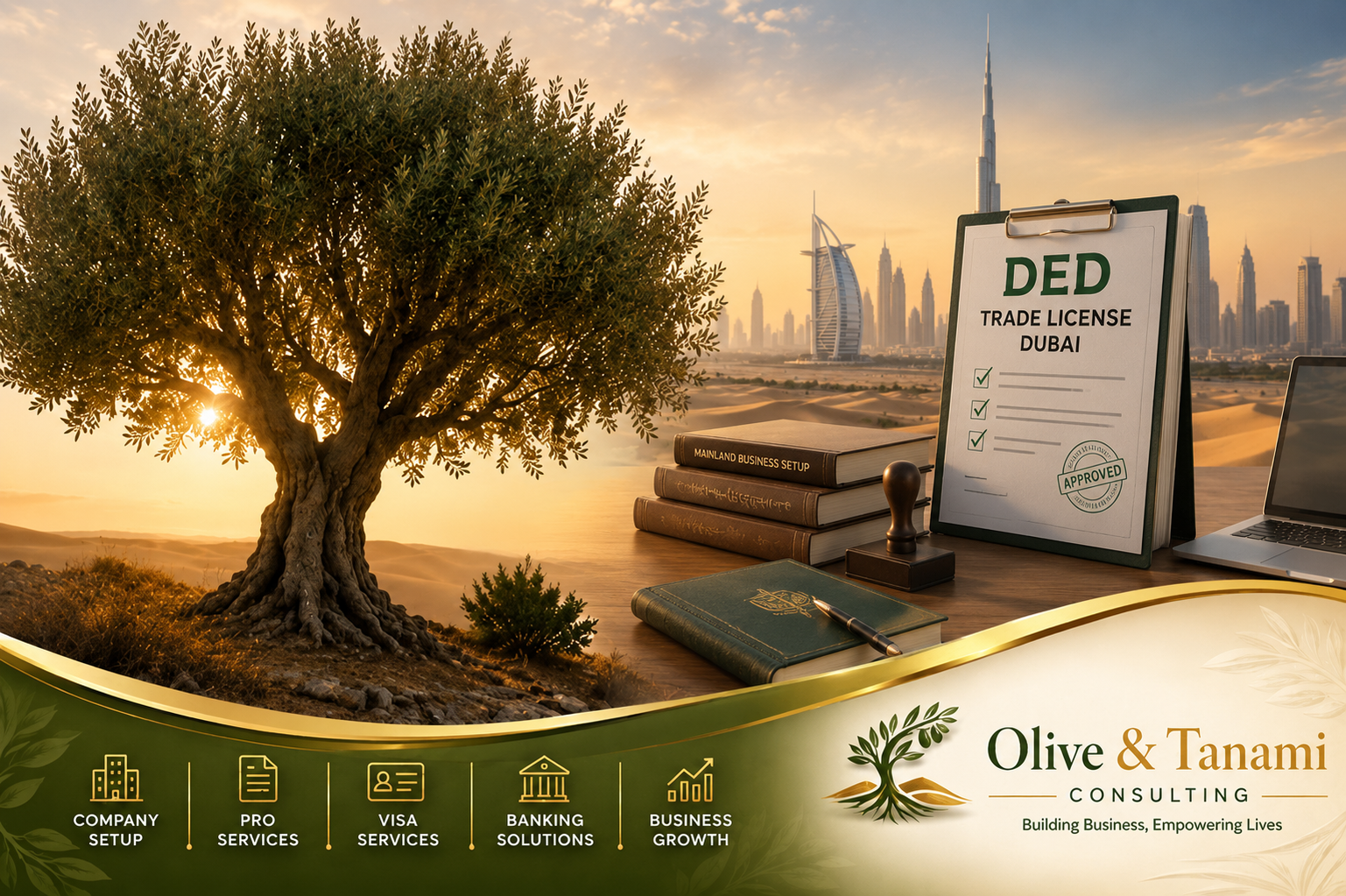
DED Trade License Dubai: Types, Costs & How to Apply
A practical guide to Dubai mainland trade licences, including licence types, business activities, costs, requirements and the application process.
What Is a DED Trade License in Dubai?
A DED trade licence is the mainland business licence issued through Dubai's Department of Economy and Tourism framework for businesses carrying out approved commercial activities in Dubai.
The licence establishes the business activities that the company is authorised to conduct and forms an important part of the legal framework for operating a mainland business in Dubai.
The appropriate licence structure depends on what the company intends to do. Trading, professional services, industrial activities and other business models can have different licensing requirements.
Your licence defines your permitted business scope.
Business Activity
The activities selected for the licence determine the business operations covered by the licence.
Legal Structure
The appropriate legal form depends on the nature and ownership structure of the business.
Regulatory Requirements
Certain activities can require additional approvals or conditions before licensing.
Which Type of DED Licence Does Your Business Need?
The appropriate Dubai mainland licence depends on the nature of the business you intend to operate. Understanding the main licence categories can help you identify the structure that best matches your planned activities.
Dubai mainland businesses can fall into different licensing categories depending on the activities they carry out. The licence category should therefore be considered alongside the business activity rather than treated as a separate decision.
Commercial Licence
Generally used for businesses engaged in commercial or trading activities.
Commonly relevant to
- Trading businesses
- Import and export activities
- Wholesale and distribution
- Certain retail activities
The specific products or trading activities must be approved under the applicable activity classification.
Professional Licence
Generally associated with businesses providing professional, specialist or service-based activities.
Commonly relevant to
- Consultancy activities
- Professional services
- Specialist service providers
- Certain individual expertise-based activities
Some professional activities can have specific qualification, approval or ownership requirements.
Industrial Licence
Relevant to businesses involved in manufacturing or other approved industrial activities.
Commonly relevant to
- Manufacturing operations
- Production activities
- Industrial processing
- Certain factory-based businesses
Industrial activities can involve additional premises, technical, environmental or regulatory requirements.
Start with the activity, then determine the licence structure.
The most suitable licence cannot be determined by the business name alone. The actual products, services and operations should be reviewed first so that the appropriate activity and licensing requirements can be identified.
Choose the Right Business Activity Before Applying for Your Licence
Your business activity is one of the first decisions to make when setting up a Dubai mainland company. It helps determine the appropriate licence category, legal structure and any additional requirements that may apply.
Start with what your company will actually do.
Choosing a licence should begin with a clear understanding of the products or services your company intends to provide. A trading company, consultancy, manufacturer and online business may require different activity classifications and licensing arrangements.
The UAE has more than 2,000 business activities across different sectors. A business may also have more than one approved activity, subject to the applicable rules and compatibility of the activities.
Do not choose the licence first and try to fit your business into it afterwards. Identify the actual activity first.
Identify the Activity
Clearly define the products, services or operations your company will conduct.
Find the Appropriate Activity
Match the proposed business model with the relevant economic activity classification.
Check Additional Requirements
Some activities can require additional approvals, qualifications, premises or regulatory conditions.
Select the Licence Structure
Once the activity is established, determine the appropriate licence and legal structure for the business.
Different businesses can require different activity classifications.
Buying, selling, distribution or other approved commercial activities.
Consultancy, specialist and other approved service-based activities.
Production, processing and other approved industrial operations.
Online selling activities may require the appropriate commercial activity and applicable approvals.
Business activities and licensing requirements should be checked against the current Dubai licensing system before submitting an application. The UAE Government provides access to business activity and licence information through official government platforms and the National Economic Registry.
How Much Does a DED Trade License Cost in Dubai?
The cost of setting up a Dubai mainland business is not determined by the trade licence fee alone. Your total setup cost can depend on the business activity, legal structure, premises, approvals and other requirements applicable to your company.
Licence cost and total business setup cost are not always the same.
A quotation that shows only the government licence fee may not represent the complete amount required to establish and operate the business. Other components can apply depending on the company structure and business requirements.
Licence & Government Fees
The licensing process involves government fees associated with registering and issuing the applicable business licence and related approvals.
Trade Name & Registration Costs
Depending on the application, separate charges can apply to trade name reservation and other registration-related services.
Office, Tenancy & Ejari Costs
Mainland businesses generally require an appropriate business address. The cost of premises can therefore become a significant part of the overall setup budget.
Additional Approvals
Certain regulated or specialised activities may require additional approvals, inspections, certificates or other government requirements.
Legal & Documentation Costs
Depending on the legal structure and circumstances of the company, costs can include document preparation, notarisation, attestation or related services.
Visa & Immigration Costs
If the business requires owner, partner or employee residence visas, additional immigration and employment-related costs will need to be considered separately.
Think beyond the licence fee.
When comparing business setup quotations, ask whether the quoted amount includes only the licence or also covers the other costs required for your specific business. This makes it easier to compare like-for-like proposals.
Your final cost depends on the structure of the business.
Some activities have additional regulatory or approval requirements.
The chosen legal form can affect the documentation and setup requirements.
Office or commercial premises can materially affect the overall setup budget.
Immigration and employment requirements add costs beyond the initial licence.
There is no single setup price that applies to every Dubai mainland business. A reliable cost estimate should be based on your exact activity, legal structure, premises requirement and any additional approvals or visas required.
What Documents Do You Need for a DED Trade License in Dubai?
The documents required for a Dubai mainland business depend on the legal form, business activity and circumstances of the applicant. Some documents are standard, while additional documents or approvals may be required for specific activities.
Documents commonly required during the licensing process
Initial Approval Documentation
The initial approval receipt and documents submitted during the earlier stages of the application process.
Lease Contract
An appropriate business premises and lease documentation are required. In Dubai, the tenancy agreement is registered through Ejari.
Memorandum of Association
Where applicable, a duly prepared and attested Memorandum of Association is required according to the legal form of the company.
Additional Government Approvals
Certain activities require approvals from the relevant government or regulatory authority before the licence can be issued.
Service Agent Agreement
Where applicable to the chosen legal form and ownership structure, a duly attested service agent agreement may be required.
Prepare the documents before submitting the application.
Having the required documents ready can help avoid unnecessary delays during the licensing process. The final checklist should be confirmed against the current requirements for your specific activity and legal structure.
How to Apply for a DED Trade License in Dubai
Setting up a Dubai mainland business involves several stages. The exact process can vary depending on the business activity, legal form and whether additional government approvals are required.
The application begins with your business activity.
Before submitting the licence application, the proposed activity and legal structure should be established. This helps determine the applicable licensing route and any additional requirements.
Identify Your Business Activity
Define the products, services or operations your company intends to conduct and identify the appropriate business activity.
Select the Legal Form
Choose the legal form that matches the business activity, ownership arrangement and requirements of the proposed company.
Reserve the Trade Name
Select and register an available trade name that complies with the applicable naming requirements and reflects the legal form of the business.
Obtain Initial Approval
Apply for the initial approval where required. This indicates that there is no objection to proceeding with the business setup, but it does not itself authorise the business to operate.
Prepare the Required Agreements
Depending on the legal form, prepare and complete the applicable Memorandum of Association or other required agreements and documents.
Secure the Business Premises
Select premises that meet the requirements applicable to the business. In Dubai, the tenancy agreement is registered through Ejari.
Obtain Additional Approvals
If your activity is regulated, obtain the required approvals from the relevant government or regulatory authorities.
Submit Documents, Pay Fees & Receive the Licence
Submit the required documents, complete the applicable payments and complete the licensing process. Once the requirements are fulfilled, the business licence can be issued.
Not every business follows exactly the same route.
Additional approvals, documents or procedures may apply depending on the activity, legal form, ownership structure and premises. The application should therefore be assessed according to the specific business rather than treated as a one-size-fits-all process.
How Long Does It Take to Get a DED Trade License in Dubai?
The time required to obtain a Dubai mainland trade licence depends on the business activity, legal structure, document readiness, premises and whether additional approvals are required.
Straightforward applications can move quickly, but regulated activities may take longer.
There is no single processing time that applies to every Dubai mainland business. Applications with complete documentation and no additional regulatory requirements can generally progress more efficiently than applications requiring external approvals or additional documentation.
Activity & Structure
Confirm the business activity, legal form, ownership structure and applicable licensing requirements.
Initial Approvals & Registration
Complete the applicable trade name, initial approval and registration procedures.
Business Address & Tenancy
Arrange suitable premises and complete the required tenancy documentation, including Ejari registration where applicable.
Additional Regulatory Requirements
Where required, obtain approvals, certificates or inspections from the relevant authorities.
Final Submission & Licence Issuance
Submit the completed documentation, settle the applicable fees and complete the final licensing requirements.
Common factors that can make an application take longer
Missing or incorrect documents can require additional submissions or corrections.
Some activities require approvals from additional government authorities.
Certain businesses may have specific premises or inspection requirements.
Changes to the activity, ownership or structure during the application can add extra steps.
If speed is important, prepare the activity, ownership details, documents and premises requirements before beginning the application. This can help reduce avoidable back-and-forth during the setup process.
Can Foreigners Own 100% of a DED Trade License in Dubai?
In most cases, foreign investors can establish and fully own a mainland company in the UAE. However, ownership rules can depend on the business activity and whether the activity falls within a regulated or strategic sector.
100% foreign ownership is available for most mainland activities.
The UAE's Commercial Companies framework allows foreign investors to own mainland companies completely for most activities. The former requirement for a 51% Emirati shareholder was removed for most businesses.
You may be able to establish your Dubai mainland company without an Emirati shareholder.
For eligible activities, the foreign investor can hold 100% of the company's ownership while operating under a mainland trade licence. This can provide greater control over the company's ownership, management and commercial direction.
The exact ownership structure should nevertheless be checked against the proposed business activity before the application is submitted.
Ownership should be checked together with the activity.
Check the Business Activity
Ownership eligibility should be assessed against the specific activity selected for the licence.
Check for Regulatory Restrictions
Certain strategic or regulated sectors can be subject to additional ownership or licensing requirements.
Choose the Appropriate Legal Form
The ownership arrangement and legal form should be structured to match the proposed business activity.
Some strategic activities have additional requirements.
100% foreign ownership should not be assumed for every activity. Strategic sectors and certain regulated activities can be subject to specific ownership, approval or licensing requirements.
Confirm ownership eligibility before choosing your structure.
The safest approach is to identify the exact business activity first and then confirm the applicable ownership and licensing requirements. This avoids structuring the company around an assumption that may not apply to the selected activity.
DED Trade License vs Free Zone License: Which Is Right for Your Business?
Both mainland and free zone companies can be suitable for businesses in the UAE. The better option depends on where you want to operate, the activities you plan to conduct, your office requirements and your wider business objectives.
Mainland companies can generally conduct business across the UAE, subject to the rules applicable to the activity.
Operations are subject to the rules of the relevant free zone and applicable UAE mainland requirements.
Full foreign ownership is available for most mainland activities, subject to applicable regulations.
Free zone companies generally allow full foreign ownership, subject to the rules of the selected free zone.
Premises must meet the requirements applicable to the business activity and licensing structure.
Office and workspace options depend on the selected free zone and licence package.
Activities are selected from the applicable mainland licensing framework.
Available activities depend on the specific free zone and licence type.
Certain mainland activities require approval from additional authorities.
Requirements can vary according to the free zone and business activity.
Often considered by businesses that want direct access to the wider UAE market.
Can be attractive where a particular free zone's ecosystem, facilities or licence structure fits the business.
Start with your business model, not the licence price.
- You plan to serve customers across the UAE.
- You want a mainland business presence.
- Your activity is better suited to the mainland licensing framework.
- You expect to operate directly within the local UAE market.
- Your business fits a particular free zone's activities or ecosystem.
- You want a free zone-specific setup model.
- Your office and operational requirements align with the free zone's facilities.
- The selected free zone offers advantages relevant to your business model.
There is no universally “cheapest” or “best” option.
The right structure depends on your activity, customers, premises, ownership, visa requirements, operating model and future plans. Comparing only the headline licence fee can therefore give an incomplete picture of the actual setup cost and suitability.
Is a DED Trade License in Dubai Right for Your Business?
A Dubai mainland licence can offer significant advantages for businesses targeting the UAE market. At the same time, the setup comes with premises, regulatory and operating requirements that should be considered before choosing the structure.
The right question is not simply whether mainland is better. It is whether mainland fits your business model.
Businesses with a strong UAE market focus may find the mainland structure particularly suitable. Businesses with different operating models may find that a free zone or another structure better matches their requirements.
Why businesses choose mainland
Direct Access to the UAE Market
A mainland structure can be well suited to businesses that intend to operate and serve customers across the UAE, subject to the rules applicable to their activity.
100% Foreign Ownership for Most Activities
Eligible mainland activities can generally be fully foreign-owned, giving international investors greater control over their company.
Broad Business Activity Options
Businesses can select activities from the applicable mainland licensing framework, including trading, professional and other permitted commercial activities.
Flexibility to Build a UAE Presence
Mainland businesses can establish premises and build an operational presence according to the needs of their business activity.
What you should plan for
Premises Requirements
Mainland businesses need an appropriate business address, and the premises requirements can vary according to the activity.
Additional Regulatory Approvals
Some activities require approvals, inspections or certificates from additional government or regulatory authorities.
Operating Costs
The total cost of operating a mainland company can extend beyond the initial licence fee and may include premises, visas, staff and other business expenses.
Compliance Requirements
Businesses must maintain their licence and comply with the requirements applicable to their activities and corporate structure.
Mainland can be a strong choice when UAE market access is central to your business strategy.
Before applying, compare the activity, ownership, premises, cost and operational requirements against your actual business plans rather than choosing a licence based only on the headline setup price.
DED Trade License Renewal, Validity & Ongoing Compliance
Getting your Dubai mainland trade licence is only the beginning. The licence, business premises, activities and related registrations must continue to meet the applicable requirements while the company remains operational.
Keep your licence and supporting requirements aligned with the business you are actually operating.
Renewal is not simply a matter of paying a fee. Before renewing, businesses should check that their licence information, activities, premises and supporting documents remain appropriate for the company's current operations.
Check Licence Details
Review the licence, legal structure, business activities and company information before renewal.
Confirm Business Premises
Ensure that the tenancy and premises arrangements satisfy the requirements applicable to the business.
Prepare Required Documents
Make sure the documents and approvals required for the renewal are available and up to date.
Complete the Renewal
Submit the renewal application through the applicable Dubai licensing channels and settle the required fees.
What should a mainland business keep track of?
A valid trade licence is only one part of maintaining an active business. Depending on the company and its activities, other registrations, approvals and operational obligations may also need attention.
Trade Licence
Monitor the licence status and renewal requirements applicable to the company.
Business Activities
Ensure the activities being conducted remain covered by the company's licensing structure.
Tenancy & Premises
Keep the relevant premises and tenancy arrangements properly maintained.
Regulatory Approvals
Track any additional approvals, certificates or inspections applicable to the activity.
Company Information
Keep ownership, contact and other registered company information accurate and current.
Immigration & Visa Matters
Where applicable, keep employee, partner and visa-related requirements properly managed.
Do not wait until the last moment to review your renewal.
If your business has changed since the licence was issued, check whether the activity, ownership, premises or other registered details need to be updated before or as part of the renewal process. Requirements can vary according to the business and its activities.
Get your licence structure reviewed before you apply.
Documents Required for a DED Trade License in Dubai
The documents required for a Dubai mainland trade licence depend on the company's legal structure, shareholders, business activity and premises. Preparing the core documents in advance can help reduce avoidable delays during the application.
The exact document list depends on your business structure.
A sole establishment, limited liability company and other legal structures can have different documentation requirements. Additional documents may also be requested where the selected activity requires external approval.
Common documents used during the mainland setup process
Passport Copies
Passport copies of the shareholders, partners or other individuals required for the application.
Emirates ID & UAE Documents
Where applicable, existing UAE identification, residency or related documents may be required for individuals already residing in the UAE.
Trade Name Information
The proposed business or trade name must comply with the applicable naming rules before registration.
Business Activity Details
The selected business activities and corresponding licensing information are required to determine the appropriate licensing route.
Memorandum of Association
Where applicable, constitutional documents such as a Memorandum of Association may be required according to the legal form of the company.
Tenancy & Premises Documents
Where premises are required, the relevant tenancy documentation and supporting property information may be required.
Additional documents or approvals may be required
Some businesses cannot be licensed using only the standard documentation. The nature of the activity, shareholder structure or source of existing documents can create additional requirements.
Additional authority approvals, certificates or inspections may apply.
Corporate shareholders may need company incorporation and ownership documents.
Certain professional activities may require qualifications, professional approvals or other supporting evidence.
Foreign-issued documents may require attestation, legalisation or other formalities depending on the document and application.
Do not prepare your documents before deciding the legal structure and activity.
The most efficient approach is to determine the proposed activity and legal form first. This allows the required documents to be identified correctly rather than preparing a generic document package that may later need to be changed.
Get a document and licensing requirements review.
Does Your DED Trade License Require Additional Approvals?
Some business activities in Dubai require approvals, permits, certificates or inspections from additional government or regulatory authorities. Identifying these requirements before submitting your licence application can help avoid delays and unexpected costs.
Your business activity determines whether additional approval may be required.
A standard commercial activity may follow a relatively straightforward licensing process. Regulated, technical or specialised activities can involve additional conditions before the business can begin operating.
Identify the Exact Activity
Determine the precise business activity you intend to conduct rather than relying only on a general description of your business.
Check Approval Conditions
Review whether the selected activity has additional regulatory, technical or operational requirements.
Obtain Required Approval
Where applicable, obtain the required approval, permit, certificate or clearance from the relevant authority.
Complete the Licensing Process
Proceed with the applicable licensing requirements once the necessary conditions have been satisfied.
Some activities may involve additional authorities
The authority involved depends on the nature of the business activity. The examples below are intended to illustrate the types of additional approvals that may arise, not to provide an exhaustive activity list.
Health & Medical Activities
Certain healthcare and medical-related activities may involve sector-specific approvals and professional requirements.
Education & Training
Certain education, training and learning activities may be subject to additional regulatory requirements.
Food & Hospitality
Food-related and hospitality businesses may require additional premises, health, safety or operational approvals.
Construction & Technical Activities
Certain technical, engineering or construction-related activities may involve specialist requirements.
Transport & Logistics
Some transport and logistics activities can be subject to activity-specific permissions and operational conditions.
Other Regulated Activities
Specialised activities may have their own authority, qualification, inspection or documentation requirements.
Check the activity before choosing the licence package.
Choosing a licence first and discovering later that your activity requires additional approval can result in changes to the application, additional documentation or delays. The activity should therefore be assessed as part of the initial setup planning.
Check the licensing requirements before you apply.
General Trading vs Specific Trading Which Licence Activity Fits Your Business?
Choosing a trading activity is an important part of setting up a Dubai mainland company. The right choice depends on the products you intend to trade, how broad your product range will be and whether particular products are subject to additional regulatory requirements.
General trading is about the breadth of products, while specific trading focuses on defined product categories.
The appropriate activity should be selected based on what the company actually intends to trade. A broader activity does not automatically mean that every product can be traded without additional approvals or restrictions.
General Trading
A broader trading model for businesses intending to deal in multiple categories of goods, subject to the applicable licensing and regulatory requirements.
Suited to businesses planning to trade across multiple permitted product categories.
Useful where the company expects its trading portfolio to cover a wider range of goods.
Can provide a broader trading framework, but individual products may still have their own regulatory requirements.
Your planned product portfolio is broad and is likely to include several different permitted categories.
Specific Trading
A more focused trading model based on defined goods or product categories relevant to the company's intended business.
Better suited to a business focused on clearly defined products or categories.
Appropriate where the company has a specialised product portfolio.
The activity is more closely aligned with the particular products the business intends to trade.
Your business has a defined product category and does not require a broad trading portfolio.
A general trading activity does not remove product-specific regulatory requirements.
Certain products can be regulated or subject to additional approvals, permits, certifications, import requirements or other conditions. The product itself should therefore be checked before finalising the trading activity.
Start with the products you actually intend to trade
Instead of choosing the broadest activity simply because it appears more flexible, map your planned products first and then determine which licensing activity best reflects the business.
List Your Products
Identify the products you expect to buy, sell, import or distribute.
Group the Categories
Determine whether your products fall within one focused category or several different categories.
Check Restrictions
Identify products that may require additional approvals or permissions.
Select the Activity
Choose the licensing activity that accurately reflects your intended trading operation.
Do not choose a trading activity based only on its name.
The important question is whether the activity appropriately covers the products and commercial operations you intend to conduct. If your product range changes later, the licensing position should also be reviewed.
Tell us what you plan to trade and we can help you assess the route.
DED Trade License Renewal Validity, Renewal & Ongoing Compliance
A Dubai mainland trade licence needs to remain valid for the business to continue operating under its licensed structure. Renewal should therefore be treated as part of the company's ongoing business administration rather than something to address only after the licence expires.
Plan your renewal before the current licence period ends.
Renewal requirements can depend on the company's current licensing details, business activity, premises and other applicable conditions. Reviewing the licence in advance gives the business an opportunity to identify changes that may need to be addressed.
What should you review before renewing?
Licence Details
Check that the business activity and licence information still accurately reflect the company.
Business Premises
Review the status of the company's premises and any tenancy-related requirements connected with the licence.
Business Activities
Consider whether the company has started or plans to start activities that are not reflected in its current licence.
Company Information
Check whether shareholder, management or other company details have changed and whether they need to be updated.
A simple way to manage the renewal
Check the Expiry Date
Keep the licence expiry date visible in your company's administrative calendar.
Review What Has Changed
Identify changes to activities, premises, ownership or other company information that may need attention.
Confirm the Current Requirements
Check the applicable renewal requirements for the company's current licensing position.
Complete the Renewal
Complete the required renewal formalities and keep the renewed licence records with the company's business documents.
An upcoming expiry date is also a good time to review your setup.
If your company has changed the nature of its operations, moved premises, added activities or changed its corporate information, renewal can be an appropriate point to review whether the current licence still matches the business.
Keep these details under regular review
Expiry and current licence details
Current and planned business activities
Current office or commercial location
Ownership and other relevant information
Need help reviewing or renewing your Dubai mainland licence?
DED Trade License Dubai Frequently Asked Questions
Here are answers to common questions about Dubai mainland trade licences, including activities, costs, renewal, premises and the general setup process.
Still deciding whether a mainland trade licence is right for you?
The right setup depends on your business activity, operating model, premises and plans for growth. A licence should be selected around the business, rather than the other way around.
01 What is a DED trade license in Dubai? +
A DED trade licence refers to a Dubai mainland commercial licence issued for permitted trading activities. The appropriate activity and requirements depend on what the business intends to trade and how it will operate.
02 Is a DED trade license the same as a mainland license? +
In common usage, a DED trade licence is used to describe a Dubai mainland commercial licence. The exact licence activity and applicable requirements depend on the business being established.
03 How much does a DED trade license cost in Dubai? +
The total cost depends on factors such as the business activity, licence requirements, premises, approvals and other setup requirements. There is therefore no single fixed total cost that applies to every business.
04 Can I choose any business activity for my company? +
No. The activity should correspond to the business you intend to conduct and must be available under the applicable licensing framework. Some activities can also have additional conditions or approvals.
05 Do I need an office for a DED trade license? +
Premises requirements depend on the business activity and the applicable licensing conditions. The office or commercial premises requirement should therefore be checked for the specific business before finalising the setup.
06 Can a foreign investor establish a Dubai mainland company? +
Foreign investors can establish businesses in Dubai mainland subject to the applicable UAE laws, licensing rules and requirements for the selected activity and legal structure.
07 Can I add more than one business activity? +
Multiple activities may be possible, depending on the activities selected and the applicable licensing rules. They should be reviewed together to ensure that the licence accurately reflects the intended business operations.
08 What is the difference between general trading and specific trading? +
General trading is intended for a broader trading model involving multiple permitted product categories, while a specific trading activity is focused on defined goods or categories. Product-specific restrictions and approvals can still apply.
09 Can I change my business activity later? +
Changes to licensed activities may be possible, subject to the applicable procedures and requirements. If your business model changes, it is advisable to review the licence before carrying out activities that are not covered.
10 How long is a Dubai trade license valid? +
A Dubai trade licence is issued for a defined validity period and must be renewed to remain active. The expiry date shown on the licence should be monitored and renewal should be planned in advance.
11 Can I renew my DED trade license online? +
Dubai provides digital channels for a range of business licensing services. The exact renewal route depends on the company's licensing position and current requirements.
12 Is a DED trade license better than a free zone license? +
Neither structure is automatically better for every business. The decision should be based on the company's activity, customers, premises, operating model, regulatory requirements and long-term plans.
13 Does a DED trade license allow me to import and export goods? +
Trading and import or export activities depend on the licensed activity and the applicable customs, product and regulatory requirements. The specific goods should be reviewed before starting import or export operations.
14 Can Olive & Tanami help me choose the right DED activity? +
Yes. Olive & Tanami Consulting can help assess your proposed business model, activities and setup requirements so you can make a more informed decision before proceeding with your Dubai company setup.
Your business is unique. Your licence structure should be too.
Tell us what you want to establish in Dubai and we can help you understand the relevant options before you commit to a setup.